
La industria automotriz en México sigue siendo uno de los motores más importantes de implementaciones 4.0 en manufactura, no solamente por la adopción tecnológica que implica sino como una necesidad de cumplimiento con requisitos de calidad y trazabilidad, que son exigencia en cadenas de suministro automotrices globales.
Core Tools in automotive manufacturing: the difference between competing on price or accessing high-value OEM projects
For many machining shops, component manufacturers, integrators, and Tier 2 or Tier 3 suppliers, the problem does not start with the ability to produce parts. It begins when customers demand objective evidence of process control. It then becomes imperative to adopt methodologies to ensure that consistent, traceable, and compliant products are manufactured according to customer requirements and international standards.
What are Core Tools?
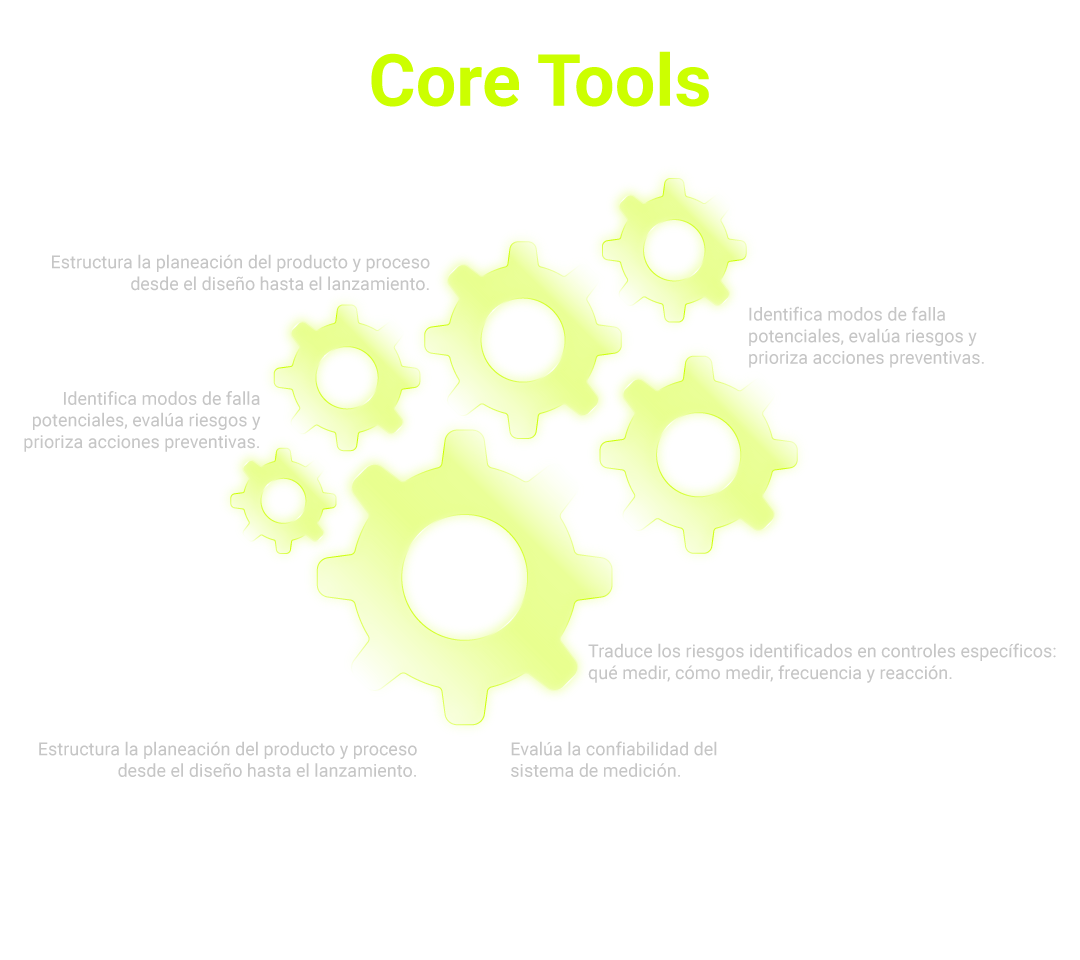
Developed by the Automotive Industry Action Group(AIAG), they are essential tools in IATF 16949, ISO 9001, APQP, PPAP, FMEA, SPC, and MSA; which, more than documents, are structured systems to reduce variability, human errors, and operational risks.
Processes without control or traceability: The real problem.
There are still processes where measurements depend almost entirely on the operator, and there is no digital traceability. Records are filled out manually, inspection occurs after parts have already been produced in series, and decisions are not made based on data, as statistical analysis of the process does not take place.
There are still productions where measurement equipment is not integrated and the information they generate is isolated in spreadsheets, revealing deviations only after they have occurred: scrap, or the customer complains.
The results are well-known history...
... High PPM, rework, high quality costs, line stoppages, and difficulty in passing automotive customer audits. Uncontrolled processes affect the ability to compete for OEM projects.
The reality is that many workshops have technical manufacturing capability but lack demonstrable process control capability.
Why do OEMs and Tier 1s require Core Tools?
When a single dimensional deviation can lead to product recalls, stoppages, legal issues, safety risks, or regulatory non-compliance, automotive OEMs require their suppliers to demonstrate the factors that minimize risks throughout their supply chain:
- Standardization: the ability of all operators to execute processes from the same criteria.
- Repeatability: processes that produce consistent results.
Traceability: who produced, when, with what tool, with what parameters, and under what conditions.
Statistical capability: a measurable and stable process.
Objective evidence: data.
Para la industria automotriz moderna no basta con "hacer bien las piezas". Requiere infraestructura que ejecute correctamente sistemas modernos de calidad.
It is extremely difficult to implement Core Tools manually, because tools like SPC, MSA, APQP, PPAP, Control Plans, capability studies, and dimensional traceability directly depend on reliable data, integration of equipment for interoperability, automation, digitalization, real-time monitoring, and reduction of human error.
SPC: Measuring is not enough
SPC (Statistical Process Control) allows monitoring process variations before there are out-of-spec parts. If data is captured manually, errors occur, there is unintentional manipulation, records are lost, and the analysis becomes unreliable.
For SPC to work correctly, the following are required: automatic data acquisition, connectivity with instruments, analysis software, traceability, alerts, and reliable digital records.
MSA: Ensuring that measurement is reliable
The MSA (Measurement Systems Analysis) evaluates whether a measurement system can truly be used to release product. It is not enough to have calipers, micrometers, comparators, or CMMs; calibration, repeatability, digital integration, environmental control, and metrological traceability are also required.
APQP y PPAP: demostrar capacidad antes de producir
El Advanced Product Quality Planning (APQP) y el Production Part Approval Process (PPAP) obligan a demostrar que el proceso puede producir consistentemente antes del arranque de producción; documentación, estudios dimensionales, trazabilidad, control de cambios, validaciones de procesos y evidencia estadística, lo que se convierte en una carga administrativa enorme, sin digitalización. Con automatización, se convierten en ventaja competitiva.
La manufactura moderna busca reducir la interpretación humana y del criterio subjetivo, construir ecosistemas robustos, trazables y estandarizados. Por eso la Industria 4.0 continúa creciendo en México: porque cada vez más empresas necesitan demostrar capacidad real de manufactura, no únicamente capacidad instalada.
Y precisamente ahí es donde las soluciones disponibles en DBLK MX aportan valor tangible para la manufactura mexicana.