
The challenge of producing parts is something that many manufacturing workshops in Mexico overcome; however, demonstrating consistent, repeatable, and traceable quality is still something that is being worked on today in order to generate more profitable projects.
If a client has ever asked you for technical documentation, dimensional studies, or evidence of process control, you are already in the PPAP territory (even if you don't call it that).
PPAP in manufacturing workshops: how to meet quality standards and win more profitable projects
It is important to be able to implement the PPAP methodology without complicating the operation, because this structure validates the ability to produce parts that consistently meet customer requirements.
The Automotive Industry Action Group (AIAG) developed an automotive quality standard that is now applied in multiple industries.
It is not bureaucracy but evidence of control and a commercial differentiator that applies not only to OEMs. If you want to scale, it is not optional.

What does a PPAP include?
A complete PPAP includes up to 18 elements:
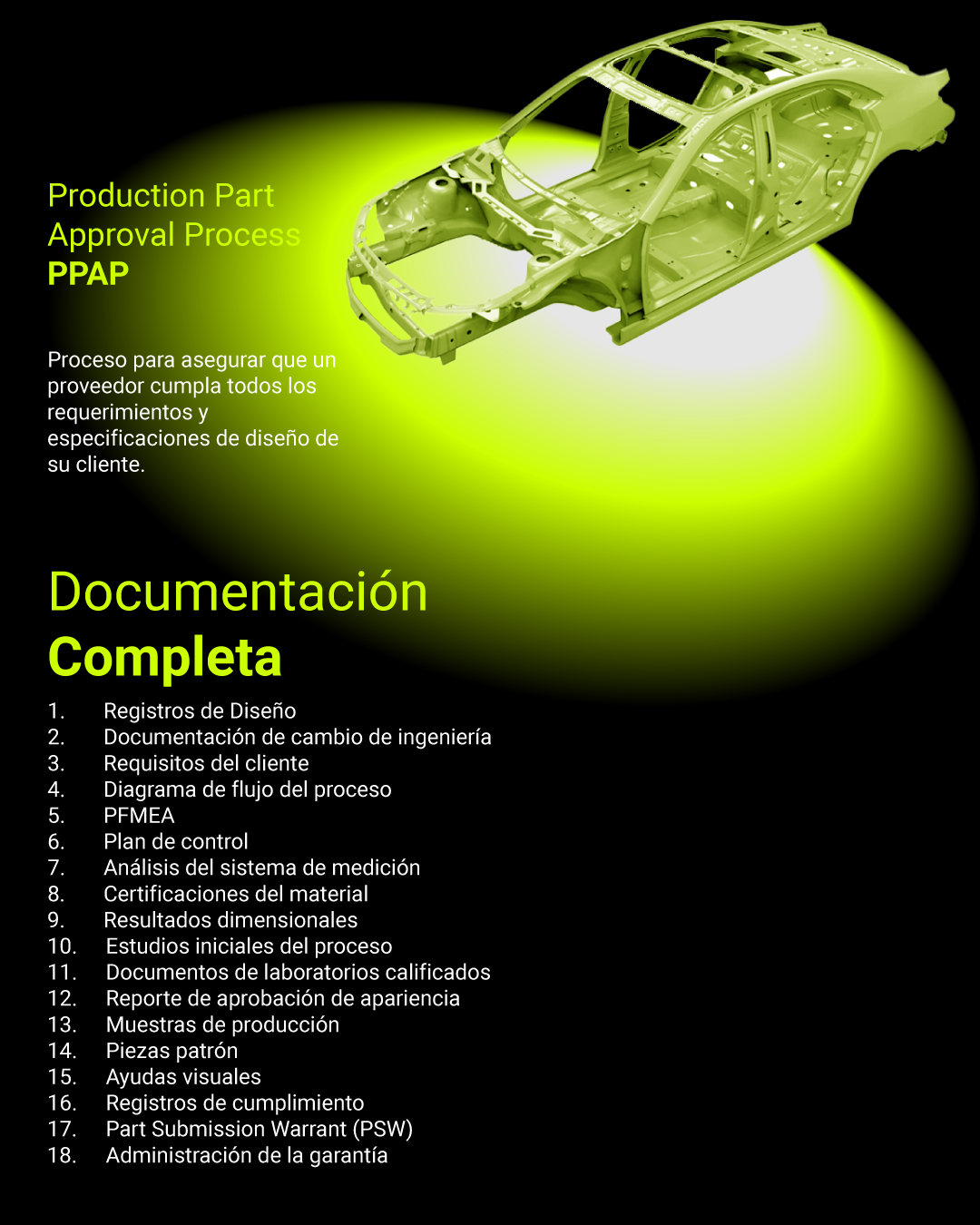
A very common mistake is not understanding how the PPAP fits into the growth strategy for your operation. Spoiler alert: "putting together" one at the end of the process is another strategic error.
Measuring is not the same as documenting correctly.
When the operation is entry-level, it is advisable to observe these critical elements of a PPAP:
- Drawings and specifications on the client's plan, where all critical characteristics (dimensions, tolerances, finishes) are shown.
- Dimensional results to compare produced parts against the blueprint.
- Capacity studies (Cp, Cpk) to demonstrate not only compliance but also stability in the processes.
- Control based on clear instructions on how the part is made.
- Physical samples of representative pieces from the production batch.
- PSW (Part Submission Warrant): The document that shows everything is in order.
The PPAP is generated automatically when you have stable processes, reliable measurements, traceable data, and real-time production control.
Let's think about the occasions when the client rejects production without a clear reason, when rework is constant and you depend on final inspection as indicators that the PPAP approach is not strategic.
You are losing larger projects and higher value jobs if there is no traceability, because without data, you are competing on price.
How to implement PPAP in a workshop (without stopping operations)
It is not necessary to transform the workshop into an automotive plant to start with what you already have; in 4 practical steps, you can create greater value:
- Standardize your measurement
- Automate data creation
- Integrate control into the process (not at the end)
- Generate reports automatically
In this way, participation in larger supply chains is possible, reducing operational risks and, of course, justifying higher prices to access more demanding customers.
What type of solutions does the PPAP facilitate?
To efficiently comply with PPAP, you need to integrate:
Advanced measurement systems such as Tesa Technology allow capturing measurements with high precision and digital connectivity.
Metrología óptica automatizada como los equipos Dr. Schneider, Vicivision y Metrios permiten medir piezas complejas en segundos, reduciendo variabilidad humana y generan data para integrar sistemas de gestión y trazabilidad para la interoperabilidad que requiere un proceso de producción controlado y en un solo flujo.
Referencias
- SixSigma.us. (2025). Production Part Approval Process (PPAP) in Six Sigma.
- AIAG. (2024). Production Part Approval Process (PPAP) Manual.